Arctic sea ice is melting at accelerating rates, amplifying global warming through reduced surface reflectivity. A Canadian geoengineering startup is now testing a controversial intervention to reverse that trend.
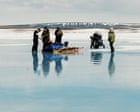
Real Ice, a company founded by engineer Andrea Ceccolini, has deployed a technique near Cambridge Bay in Nunavut to thicken Arctic sea ice. The method involves spreading a reflective powder across ice surfaces to reduce solar absorption and slow melt rates. Early field observations show visible differences. Where the powder was applied, ice retained its white surface and surrounding meltwater ponds remained absent. Adjacent untreated ice showed sky blue meltwater pools forming within days.
"This would have been a wild dream a year ago," Ceccolini said while standing on the experimental ice. The stark visual boundary between treated and untreated surfaces demonstrates the intervention's immediate physical effects.
Arctic sea ice loss accelerates climate change through albedo reduction. White ice reflects incoming solar radiation back to space. As ice melts, darker ocean water absorbs more heat, warming the region faster than the global average. Loss of summer Arctic sea ice has contributed to measurable atmospheric warming and disrupted weather patterns across the Northern Hemisphere.
The experiment represents a geoengineering approach to climate adaptation rather than mitigation. Instead of reducing greenhouse gas emissions, it attempts to modify local conditions to preserve existing ice. Such techniques remain contentious within the climate science community. Critics worry about unintended ecological consequences and the risk that geoengineering deployment might reduce political pressure for emissions reductions.
Real Ice's backers believe the intervention could buy time while global decarbonization efforts accelerate. The technical challenge involves scaling the approach across thousands of square kilometers of Arctic ice annually. Logistical costs and environmental impacts of large-scale powder deployment remain uncertain.
The Arctic contains feedback loops that amplify warming. Preserving