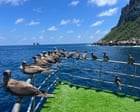
A marine journalist joined a research expedition to Darwin and Wolf Islands in the Galápagos archipelago to document how critically endangered species respond to rapid ocean changes. The remote islands off Ecuador's coast host ecosystems that remain among Earth's most intact, yet face mounting pressure from warming waters and shifting currents.
The expedition focused on species dependent on these northern Galápagos waters. Rising sea temperatures alter nutrient availability and force fish populations to migrate, disrupting food chains that support hammerhead sharks, Galápagos penguins, marine iguanas, and other endemic species found nowhere else on Earth. Ocean acidification compounds these stressors by affecting calcifying organisms like corals and pteropods that form the base of local food webs.
Darwin and Wolf Islands sit at the convergence of multiple ocean currents. The Humboldt Current delivers cold, nutrient-rich water that fuels exceptional marine productivity. El Niño events increasingly disrupt this pattern, causing sea surface temperatures to spike dramatically. During severe El Niño years, breeding seabirds starve and marine reptiles abandon traditional nesting sites.
Research teams monitor populations of species like the flightless cormorant, found only in the Galápagos and numbering fewer than 2,000 individuals. They track Galápagos penguins, the rarest penguin species with roughly 1,200 breeding pairs remaining. These animals cannot adapt quickly enough to environmental shifts unfolding across years rather than decades.
The journalist's presence on the research vessel underscores how expedition journalism documents conservation realities. Firsthand observation of underwater biodiversity, paired with scientist interviews, reveals both the irreplaceable nature of these ecosystems and their vulnerability. The Galápagos remain protected under Ecuador's environmental law, yet ocean warming operates beyond national boundaries.
These islands inspired Darwin's