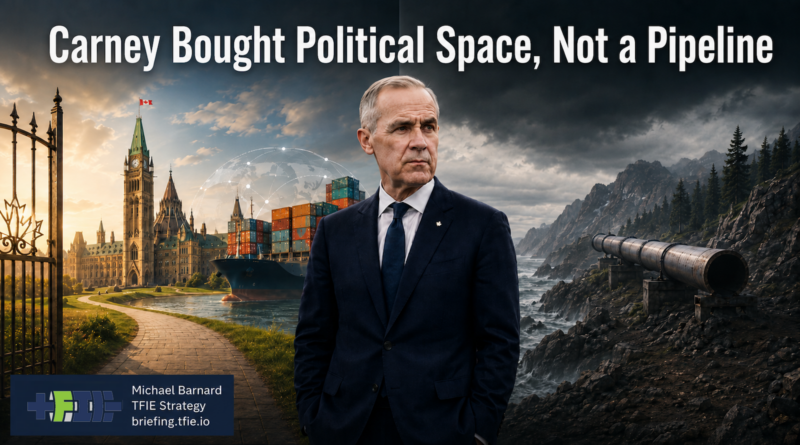
Prime Minister Mark Carney's new Alberta pipeline deal functions as political theater rather than concrete infrastructure development, according to analysis of the agreement's actual funding and feasibility.
The deal operates primarily as a strategy to project market-friendly governance and diversify trade partnerships. Carney gains three political assets from the announcement: a "Canada is open for business" messaging platform, a visible trade diversification initiative to reference during economic discussions, and a tool to neutralize political opponents who criticize energy sector policies.
The pipeline itself lacks secured funding mechanisms. The announcement presents the project as a future possibility rather than an imminent construction undertaking. This distinction matters because unfunded infrastructure announcements often serve as political cover without translating into operational capacity.
The timing reflects broader Canadian political dynamics. Energy sector relationships with provinces remain contentious. Alberta specifically has demanded pipeline expansion as a condition for supporting federal climate policies and economic strategies. Carney's announcement addresses that provincial pressure while avoiding immediate capital commitments.
The deal's infrastructure component remains secondary to its political utility. Real pipeline projects require substantial financing, regulatory approval from multiple jurisdictions, and environmental assessments. None of these elements appear finalized based on available information about the agreement.
This pattern reflects how governments increasingly use infrastructure announcements for domestic political signaling. The announcement generates headlines and demonstrates responsiveness to provincial concerns without obligating immediate expenditure or locking the federal government into controversial long-term energy commitments.
Energy policy observers note that such political pipelines frequently fail to advance beyond the announcement phase. Actual pipeline construction depends on sustained private investment, stable regulatory environments, and ongoing economic justification. A politically motivated announcement alone addresses none of these requirements.
The distinction between strategy and infrastructure matters for climate accountability. Canada's emissions reduction targets depend on actual energy system transitions, not announcement cycles. Carney's deal prioritizes political positioning over measurable progress toward either pipeline construction or alternative energy development.