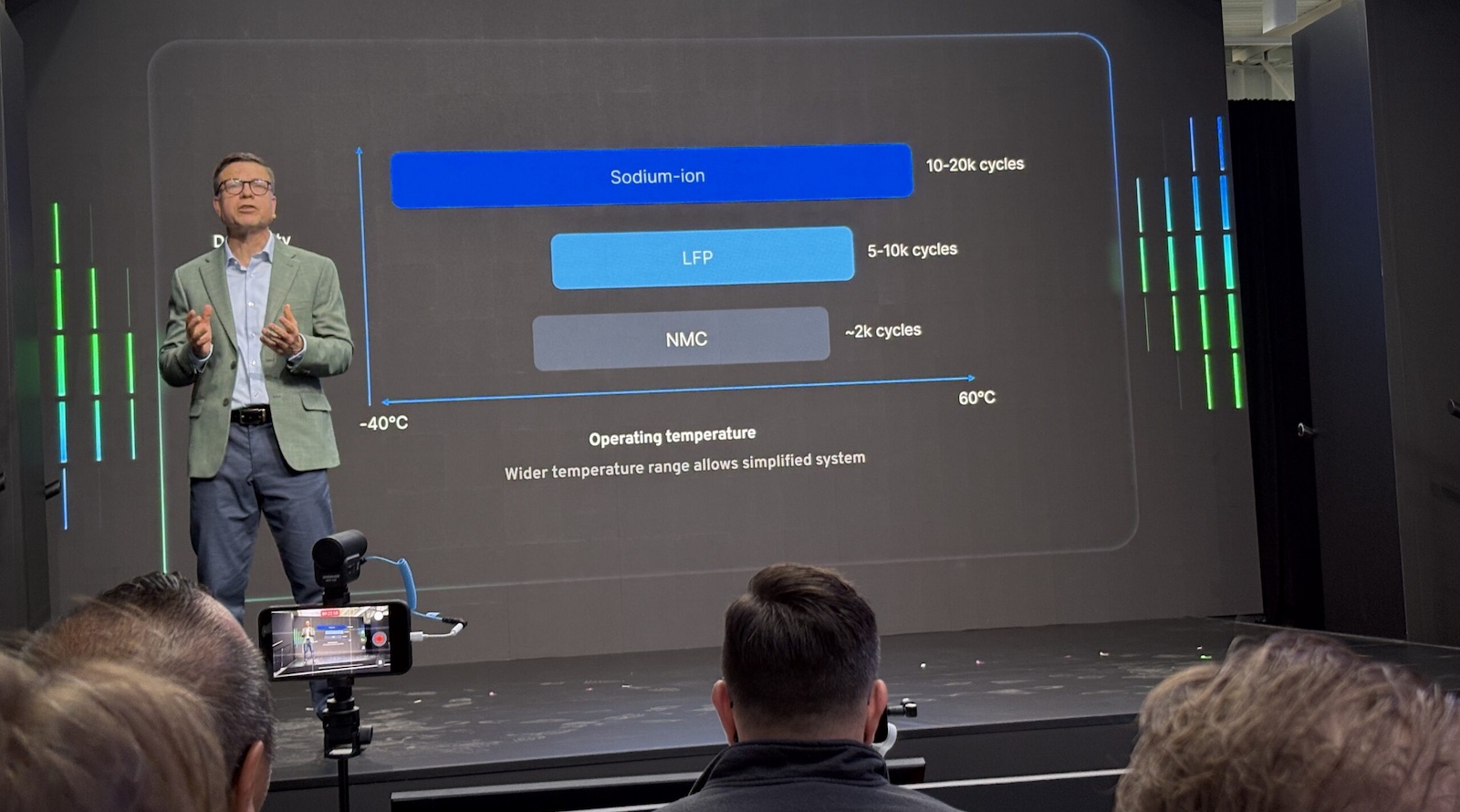
General Motors announced development of sodium-ion grid-scale battery storage manufactured in the United States, marking a shift toward alternative battery chemistry for stationary power applications. The announcement came during GM's Empower event in San Francisco on June 9.
Sodium-ion batteries offer distinct advantages over lithium-ion systems for grid storage. They use abundant, lower-cost materials with reduced supply chain vulnerability. Sodium resources face fewer geopolitical constraints than lithium, cobalt, and nickel. The technology performs well in high-temperature environments and delivers competitive cycle life, making it suitable for long-duration energy storage applications that stabilize renewable power integration.
GM's domestic manufacturing commitment addresses supply chain resilience concerns. U.S. production reduces dependence on overseas battery suppliers and supports domestic clean energy infrastructure development. Grid-scale storage plays a critical role in managing variable renewable generation, smoothing demand peaks, and preventing blackouts as utilities transition away from fossil fuel baseload power.
The automaker simultaneously activated vehicle-to-grid capability for existing customers without requiring hardware modifications. V2G technology enables EVs to discharge stored power back to the grid during peak demand periods, transforming vehicle batteries into distributed energy resources. This capability increases grid flexibility while potentially generating revenue for EV owners through demand response programs.
GM's three-pronged approach targets complementary infrastructure needs. Vehicle batteries handle distributed, mobile storage. Stationary sodium-ion systems address utility-scale, long-duration requirements where weight and space constraints don't apply. The combination leverages each technology's strengths while diversifying battery supply chains.
Sodium-ion batteries currently lag lithium-ion in energy density, limiting their use in vehicles where weight matters. For fixed grid applications storing energy over hours or days, this trade-off becomes acceptable. Several battery manufacturers, including CATL and Monolith, have commercialized sodium-ion production at scale.