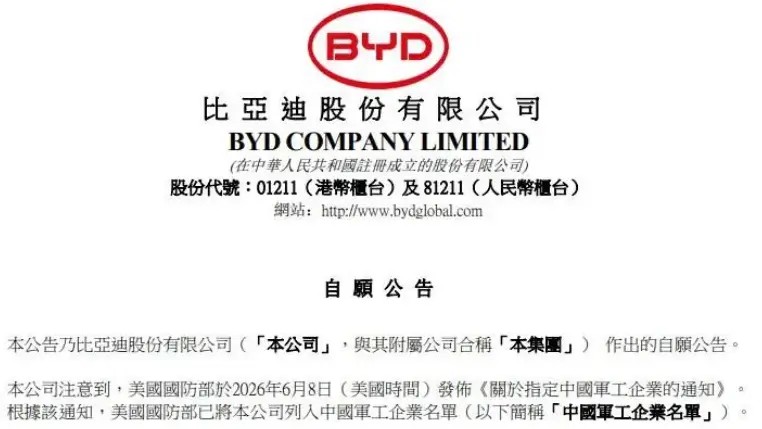
BYD, the world's largest electric vehicle manufacturer, issued a statement to the Hong Kong Stock Exchange denying claims that it operates as a Chinese military company. The statement followed a U.S. Department of Defense notification placing BYD on a blacklist of firms allegedly connected to Chinese military interests.
BYD's response contests the designation, arguing that the company operates as a civilian commercial enterprise focused on battery manufacturing and vehicle production. The automaker manufactures lithium-ion batteries for electric vehicles and energy storage systems globally. BYD supplies components to international manufacturers and sells vehicles in over 70 countries.
The Department of Defense listing carries implications for U.S. business activity. American investors face restrictions on transactions with blacklisted entities under provisions related to Chinese military-industrial complex involvement. The designation does not immediately prohibit U.S. consumers from purchasing BYD vehicles, but it affects institutional investment and potential supply chain partnerships with American companies.
This action reflects broader U.S. policy scrutiny of Chinese technology firms. The Pentagon maintains lists of companies it identifies as supporting Chinese military modernization efforts. BYD joins other Chinese tech and manufacturing firms facing similar designations, though the company disputes the characterization.
BYD ranks as the leading global EV manufacturer by sales volume, shipping 1.57 million new energy vehicles in 2023. The company dominates the Chinese battery market and supplies cells to Tesla and other international automakers. Its battery division, BYD Battery, operates production facilities across Asia and Europe.
NIO, another Chinese EV manufacturer, similarly issued a response to the listing, rejecting military affiliation claims. Both companies assert their status as independent commercial entities subject to civilian corporate governance.
The blacklist designation creates friction in an already tense U.S.-China technology competition. BYD's global supply chain involvement means the restrictions could affect battery availability for EV makers