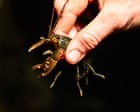
Australia's spiny crayfish, found only in isolated rainforest creeks, face extinction as global heating transforms their habitat. Researchers working in Queensland's remote waterways report that rising temperatures and changing water chemistry are making streams uninhabitable for these endemic crustaceans.
The spiny crayfish serves as an early warning system for broader ecosystem collapse. These small invertebrates depend on cool, oxygen-rich water flowing through rocky creek beds. When temperatures climb and drought stress reduces water flow, the conditions that sustained these species for millennia disappear within years.
Ollie Scully, a conservation biologist, conducts nighttime surveys in undisclosed creek locations to monitor remaining populations. His team documents how warming drives crayfish into ever-smaller refugia, compressing viable habitat into isolated pools. Once these final strongholds exceed thermal thresholds, recovery becomes impossible.
The crayfish exemplify a broader threat to Queensland's rainforest fauna. Endemic species with restricted ranges face no alternative habitats. Unlike mobile animals that can migrate, creek-dwelling invertebrates anchored to specific water systems have nowhere to retreat. The loss of spiny crayfish signals that aquatic ecosystems throughout the region operate near their thermal limits.
Climate projections for eastern Australia show continued warming will intensify dry periods and increase water temperatures. Creeks that presently support diverse species will become hostile environments within decades. Conservation efforts focus on identifying populations in cooler microclimates and preserving water quality, but these measures cannot counteract systemic heating.
The spiny crayfish fight represents a larger conservation crisis unfolding across Australia's biodiversity hotspots. Without substantial emissions reductions, incremental protection strategies will simply delay extinctions. The species demands urgent action to reduce global heating, not merely local management of symptoms.