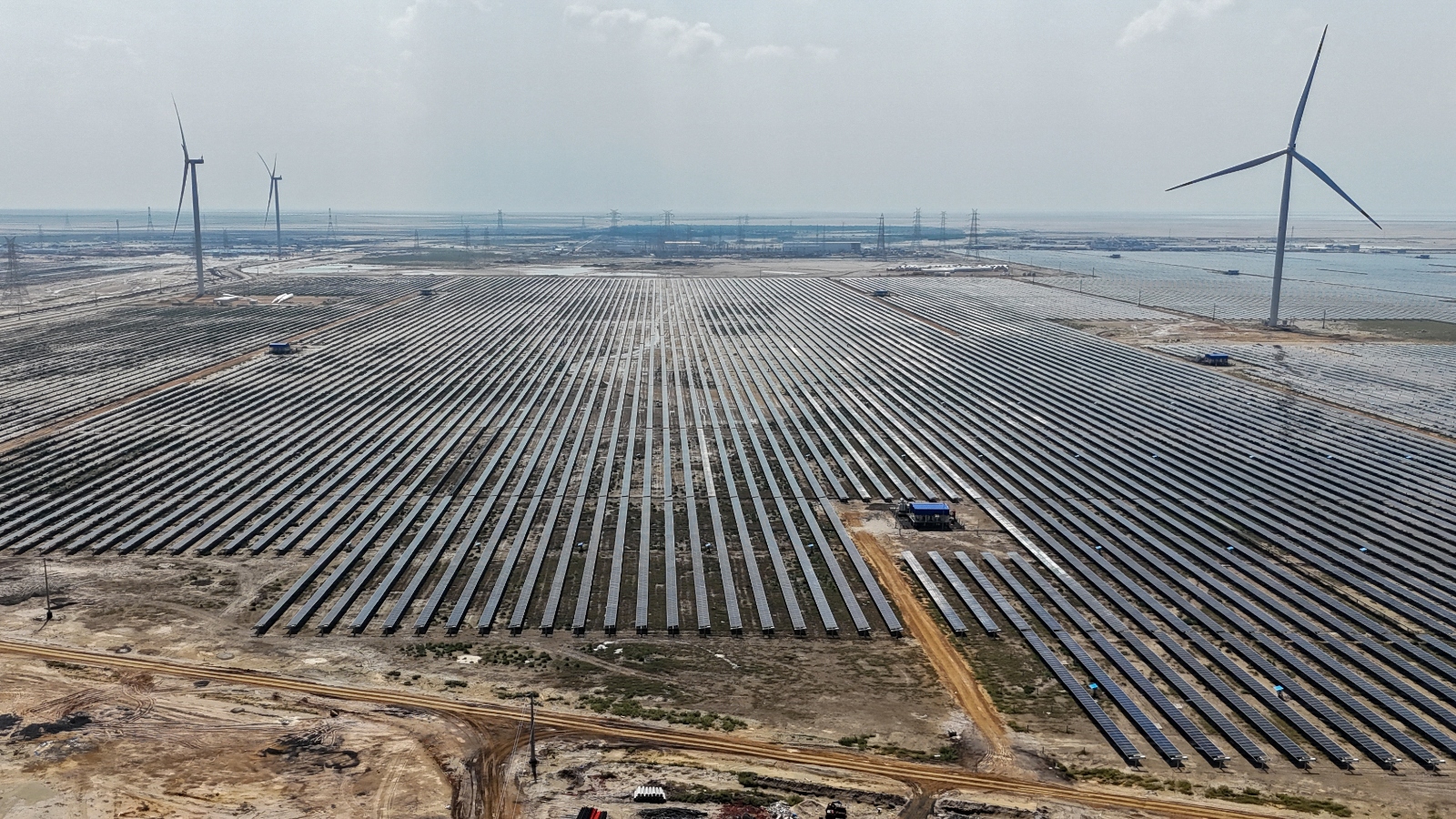
India is deploying solar energy at scale to power its industrial growth, positioning itself as the first major manufacturing nation to industrialize primarily through renewable energy rather than fossil fuels.
The country has expanded solar capacity dramatically over the past decade. India installed 13 gigawatts of solar in 2022 alone, according to the International Energy Agency. By 2023, India's total installed solar capacity reached approximately 70 gigawatts, making it the fourth largest solar market globally. Government targets call for 500 gigawatts of renewable energy capacity by 2030, with solar representing the bulk of this expansion.
This shift reflects economics more than environmental commitment. Solar costs have collapsed. In India, utility-scale solar now costs $30 to $40 per megawatt-hour, undercutting coal plants. Manufacturing zones across Gujarat, Tamil Nadu, and Maharashtra increasingly rely on solar farms rather than grid power from coal plants. Major industrial zones have begun powering factories directly from solar arrays.
The implications extend beyond India. As the nation demonstrates that rapid industrialization need not depend on coal infrastructure, other developing economies face a different calculus. Countries pursuing manufacturing growth can leapfrog coal entirely. Vietnam, Indonesia, and Bangladesh watch India's model closely.
India still relies on coal for roughly 70 percent of its electricity generation. The country built new coal plants through 2023 and continues mining coal at record levels. Solar expansion has supplemented rather than replaced fossil fuels so far. Yet the trajectory points clearly toward renewable dominance in new capacity additions.
The World Resources Institute projects that renewables will account for 80 percent of India's new electricity generation through 2030. Solar's cost advantage makes this projection credible. Without subsidies or carbon pricing, solar economics now win on merit.
India's approach differs from wealthy nations that industrialized on coal then gradually transitioned