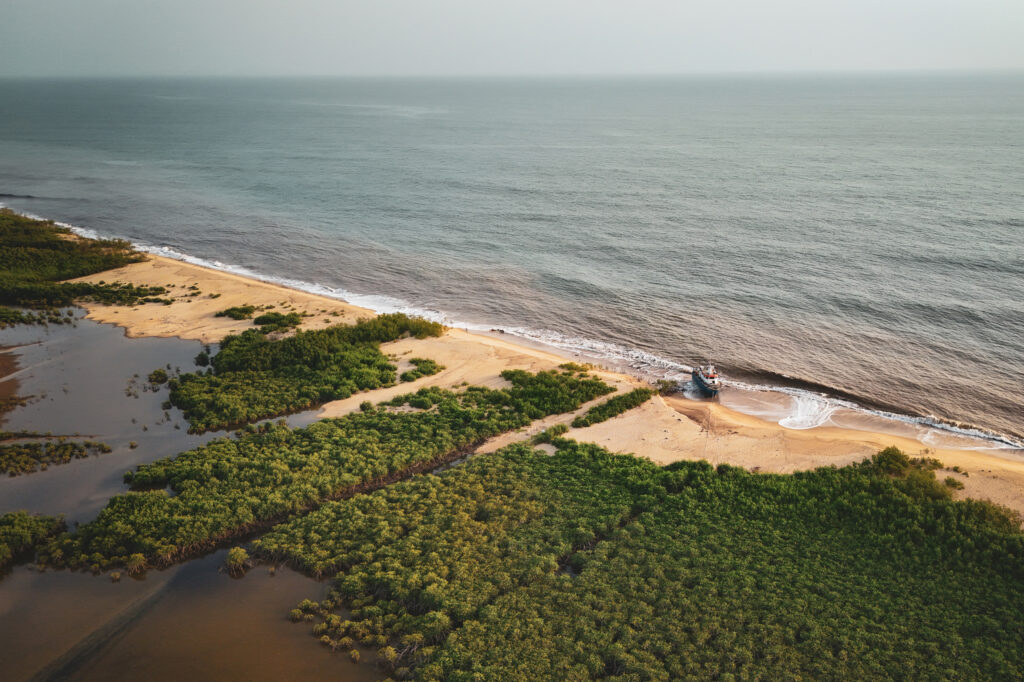
Mangrove forests sequester carbon at rates exceeding tropical rainforests and shield coastlines from storms, but climate modeling reveals these ecosystems face collapse under accelerating environmental stress. A new study warns that mangroves, evolved to withstand saltwater inundation over millions of years, confront an unprecedented convergence of threats that outpace their adaptive capacity.
The research models how rising sea levels, increased salinity fluctuations, and warming temperatures interact to degrade mangrove survival rates. These trees store carbon in both biomass and sediments, with studies showing mangroves lock away up to four times more carbon per unit area than upland forests. Coastal mangrove ecosystems store roughly 3.4 billion metric tons of carbon globally. Their loss would release this stored carbon while eliminating natural barriers protecting populated shorelines from extreme weather.
The modeling study examines tipping points where environmental conditions exceed mangrove tolerance thresholds. Rapid sea-level rise forces trees into deeper water, while simultaneous warming alters precipitation patterns and increases salt stress. Mangroves require specific hydrological conditions—their root systems depend on precise salinity balances. Accelerating change compresses the timescale for adaptation.
Mangrove loss accelerates in Southeast Asia, West Africa, and Central America, where conversion to aquaculture and agriculture already destroyed roughly 35 percent of global mangrove coverage since 1980. Climate impacts now compound human pressures. Where mangroves retreat, coastal communities lose storm protection and fishing grounds while carbon emissions spike.
The study arrives as coastal nations draft climate adaptation strategies. Mangrove restoration projects expand in Bangladesh, Indonesia, and Vietnam, though replanting alone cannot offset broader climate impacts without emissions reductions. Protecting existing mangrove stands proves more effective than restoration, yet enforcement remains weak across developing nations with limited resources.