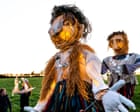
A Cornish art collective called The Lost Giants staged an elaborate New Year's Eve celebration in Lostwithiel featuring giant effigies that emerged from across the town, drawing residents into a mass procession with lights, drums, and music. The event revived an ancient tradition of goliath-making, a practice with roots in medieval and folk cultures.
The collective aims to expand this practice by engaging the public in creating their own enormous figures. Lisa Schneidau, an environmentalist and author who participated in the celebration, described the experience as transformative, noting how residents streamed from their homes to join what became a communal spectacle.
The Lost Giants operates as a creative force seeking to restore cultural practices that have largely disappeared from modern celebration. By reintroducing giant-making to contemporary communities, the collective taps into participatory art traditions that foster public engagement and shared cultural experiences.
Giant-making carries environmental and social dimensions worth examining. The project emphasizes community participation over passive consumption, building local connection through collaborative creation. Materials and methods matter for sustainability. The collective's approach appears focused on accessible, inclusive practices that draw ordinary residents into artistic production rather than outsourcing to specialists.
This revival occurs within broader cultural shifts toward participatory and community-centered art. Events like Lostwithiel's New Year's celebration demonstrate how traditional practices can anchor contemporary communities and create meaningful public gatherings. The giants themselves function as focal points that transform private spaces into shared communal territory.
The Lost Giants' model invites replication elsewhere. By democratizing giant-making and positioning it as a skill anyone can develop, the collective challenges the notion that elaborate public art requires professional credentials. This approach potentially strengthens local cultural identity while reducing reliance on commercial entertainment.
The practice also offers counterweight to digital culture by demanding physical presence, collaborative labor, and face-to-face community gathering. Whether this revival gains