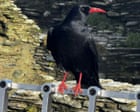
Red-billed choughs have returned to Tintagel Castle in Cornwall after vanishing from the coastal cliffs for decades, English Heritage and local ornithologists confirmed. The corvids, with their distinctive red beaks and feet, once thrived at the legendary site but had completely disappeared from the area.
Choughs require specific habitat conditions. These birds nest in cliff crevices and feed on insects in short grassland. Agricultural intensification and habitat loss drove them from most of Britain by the 1980s. The species survived in small populations along the Celtic fringe, particularly in Wales and small pockets of southwestern England.
The reappearance at Tintagel represents a recovery milestone. Conservation efforts across southwest England have focused on protecting coastal grasslands and reducing pesticide use that depletes insect populations. English Heritage manages Tintagel's habitat with these requirements in mind, maintaining the low-intensity grazing and native vegetation necessary for chough survival.
Choughs hold deep cultural resonance in Cornwall. Arthurian legend holds that King Arthur transformed into a chough upon death, his red feet and beak symbolizing his bloody end. The bird appears on the Cornish flag and remains integral to local identity.
The UK breeding population of choughs currently numbers roughly 25 to 35 pairs, making each recolonization event ecologically significant. Wales harbors the strongest population with around 50 pairs. Recent decades have seen modest range expansion from dedicated reintroduction work and habitat restoration, particularly in Devon and Cornwall.
Tintagel's clifftop environment offers ideal chough conditions. The castle overlooks steep granite faces where birds can shelter, and surrounding grasslands provide hunting grounds for their preferred diet of spiders, ants, and other invertebrates. The return demonstrates that when suitable habitat persists, choughs can reestablish themselves.
The