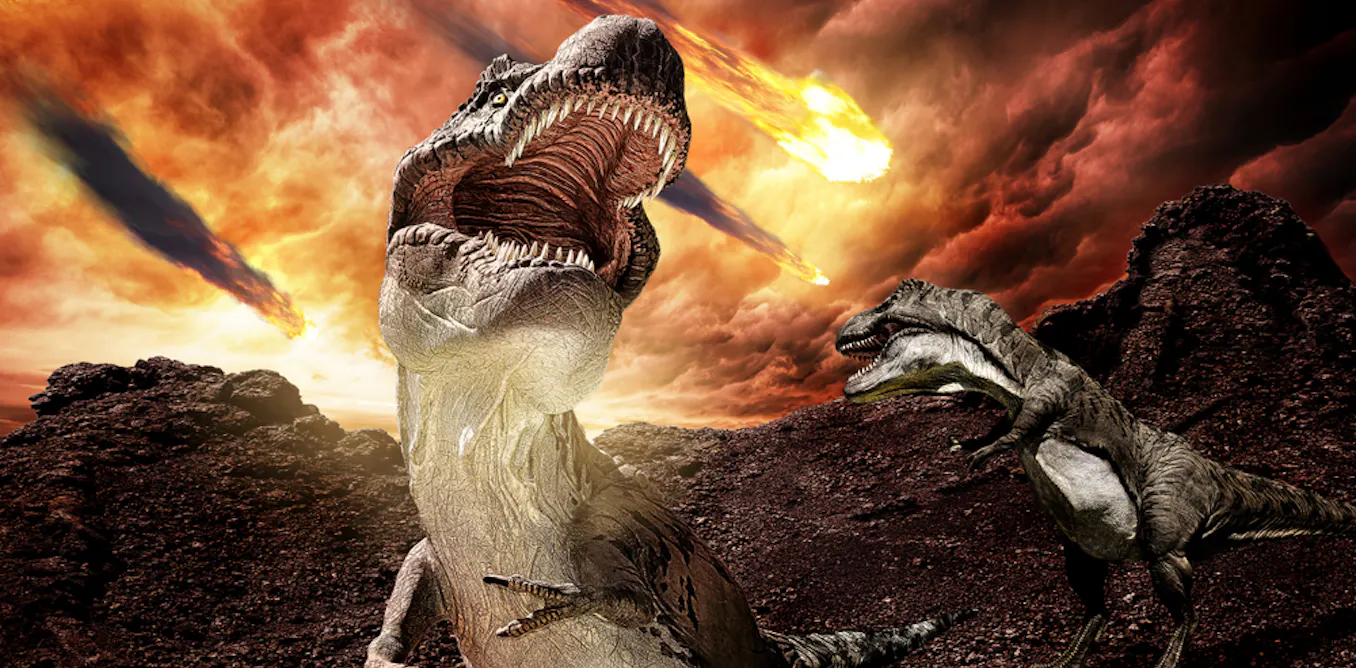
The Chicxulub asteroid strike 66 million years ago unleashed devastation across minutes, hours, and days that reshaped Earth's biosphere permanently. New climate modeling reconstructs the sequence of catastrophic events that killed 75 percent of all species.
Impact occurred in what is now Mexico's Yucatan Peninsula. The asteroid vaporized rock instantly, ejecting debris and dust into the stratosphere. Within hours, wildfires ignited across continents from thermal radiation. Temperatures spiked dramatically before plummeting as dust blocked sunlight.
By day one, darkness engulfed the planet. Photosynthesis halted. Surface temperatures dropped toward freezing despite the initial heat pulse. Sulfur aerosols from vaporized rock entered the atmosphere, reflecting solar radiation and triggering a "impact winter" lasting months.
A week after impact, the planet became chemically hostile. Rotting vegetation accumulated as plants died from darkness and cold. Smoke and sulfur combined to create acid rain that fell across the globe. Survivors faced corrosive precipitation alongside starvation from collapsed food chains. Herbivores starved as vegetation vanished. Carnivores followed when prey disappeared.
Oceans experienced similar collapse. Phytoplankton required sunlight for photosynthesis. Their death triggered cascading failures throughout marine food webs. Many fish species perished. Surviving aquatic organisms faced acidifying waters.
The recovery lasted millennia. Dust settled over years. Sunlight gradually returned. Plants slowly reestablished. Mammals and birds, better equipped to survive harsh conditions through small body size and metabolic flexibility, gradually diversified into ecological niches vacated by dinosaurs.
This reconstruction matters because it illuminates how quickly Earth's climate system responds to catastrophic perturbations. Modern climate science applies similar modeling techniques to understand potential