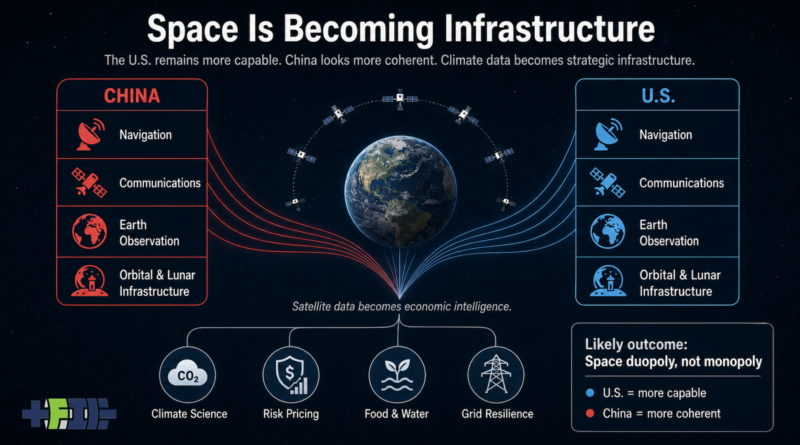
China is rapidly establishing dominance in space-based climate infrastructure, a sector Western analysts have systematically underestimated. The country's satellite capabilities now shape global emissions monitoring, renewable energy deployment tracking, and climate data collection in ways that give it structural advantage in the energy transition.
Earth observation satellites operated by Chinese agencies provide real-time data on deforestation, water resources, and agricultural productivity across Asia, Africa, and Latin America. This intelligence informs infrastructure investment decisions worth hundreds of billions of dollars. Countries investing in solar and wind farms increasingly rely on Chinese satellite data for site selection and performance monitoring.
The pattern reflects a broader miscalculation in Western assessments of Chinese technological capacity. Previous underestimations proved wrong in solar manufacturing, where China captured 80 percent of global panel production. The same trajectory is repeating in battery manufacturing and EV production. In space infrastructure, China operates more active Earth observation satellites than any other nation and launches more missions annually than all other countries combined.
Space-based climate infrastructure includes not just observation systems but communication networks enabling smart grid technology and renewable energy coordination. Chinese companies like China National Space Administration and commercial operators build these systems domestically and export them to developing nations, embedding Chinese technical standards into global climate infrastructure.
The strategic stakes are substantial. Nations that control climate data infrastructure influence how adaptation resources flow and which emissions reduction strategies gain priority. Satellite networks generate the baseline measurements against which climate progress gets assessed. China's investments in this sector position it to shape global climate policy conversations for decades.
Western governments and private companies have begun responding. NASA and NOAA expanded Earth observation initiatives. ESA launched new monitoring missions. But these efforts operate with smaller budgets and longer development timelines than Chinese programs. The competitive advantage Chinese operators built through sustained investment may prove difficult to overcome.
THE TAKEAWAY: Space-based climate infrastructure is becoming as strategically important as terrestrial energy systems, and