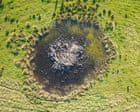
A German V2 rocket crater in east London, created in February 1945, has transformed into a thriving wildlife pond after nearly 80 years of natural recovery. The crater at Walthamstow Marshes now hosts diverse aquatic plants and species, demonstrating nature's capacity to colonize disturbed landscapes with minimal human intervention.
Luke Boyle, a ranger for the Lee Valley Regional Park Authority, describes the site as "punching above its weight" despite its small size. The pond's success stems from its unmanaged hydrology, allowing natural water accumulation and sediment deposition to create conditions for plant and animal life.
This British example finds a contemporary parallel in Ukraine, where scientists studying land obliterated by recent Russian military strikes have documented similar patterns of ecological recovery. Researchers investigating blast zones approximately 1,500 miles away report observing "how quickly nature begins to heal itself" in heavily damaged terrain.
The research underscores a counterintuitive ecological principle: severely disturbed sites can recover rapidly when left undisturbed by human management. Crater ponds and similar bomb-damaged landscapes create novel wetland habitats that attract vegetation and wildlife seeking suitable breeding grounds and food sources.
The Walthamstow crater pond case study carries implications for post-conflict ecological restoration. Rather than imposing intensive management regimes on war-damaged land, passive recovery strategies may prove more efficient and cost-effective. Natural processes of water infiltration, sediment settling, and biological colonization can restore habitat function within decades rather than centuries.
Current conditions at the site reveal sprouting aquatic plants in early spring, indicating the seasonal cycles that support diverse fauna. The pond's isolation from human manipulation has preserved these natural cycles without interference.
These findings challenge conventional restoration ecology, which often emphasizes active management and intervention. The data from both World War II-era London and contemporary Ukraine