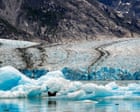
A 481-metre tsunami struck Tracy Arm fjord in southeast Alaska in August 2024, becoming the world's second-tallest recorded wave. Researchers linked the mega tsunami directly to a massive rockslide at a glacier's terminus, driven by climate-driven glacier retreat and destabilization. The wave reached heights equivalent to 1.5 times the Eiffel Tower.
The fjord hosts cruise ships regularly, placing thousands of passengers at risk from similar events. Scientists warn that accelerating glacier collapse across Alaska's coastal regions creates mounting hazards for maritime traffic and coastal infrastructure. As glaciers retreat due to warming temperatures, they expose unstable rock faces and reduce the structural support that keeps slopes intact. Meltwater infiltration further weakens glacier-adjacent terrain, priming rockslide conditions.
This tsunami represents a growing class of climate-linked disasters. Unlike traditional earthquakes that generate most tsunamis, glacier-triggered events occur without seismic warning systems. Researchers stress that existing maritime safety protocols do not adequately account for rockslide-generated waves in fjords and narrow waterways where wave amplification can be extreme.
Alaska contains thousands of temperate and alpine glaciers. Studies show retreat rates accelerating across the state. Each destabilized glacier presents a potential rockslide hazard. The Tracy Arm event demonstrates that hazard realization requires no earthquake. Scientists call for updated tsunami warning systems tuned to detect rapid water displacement from landslides, not just seismic activity.
Cruise operators and fisheries depend on these waters. The Alaska coast attracts over one million cruise passengers annually. Researchers recommend revised coastal hazard assessments, improved monitoring of unstable glacier-adjacent slopes, and new warning infrastructure. Without intervention, future rockslide tsunamis pose escalating risks to vessels and coastal communities.
THE TAKEAWAY: Climate-driven glacier retreat in Alaska