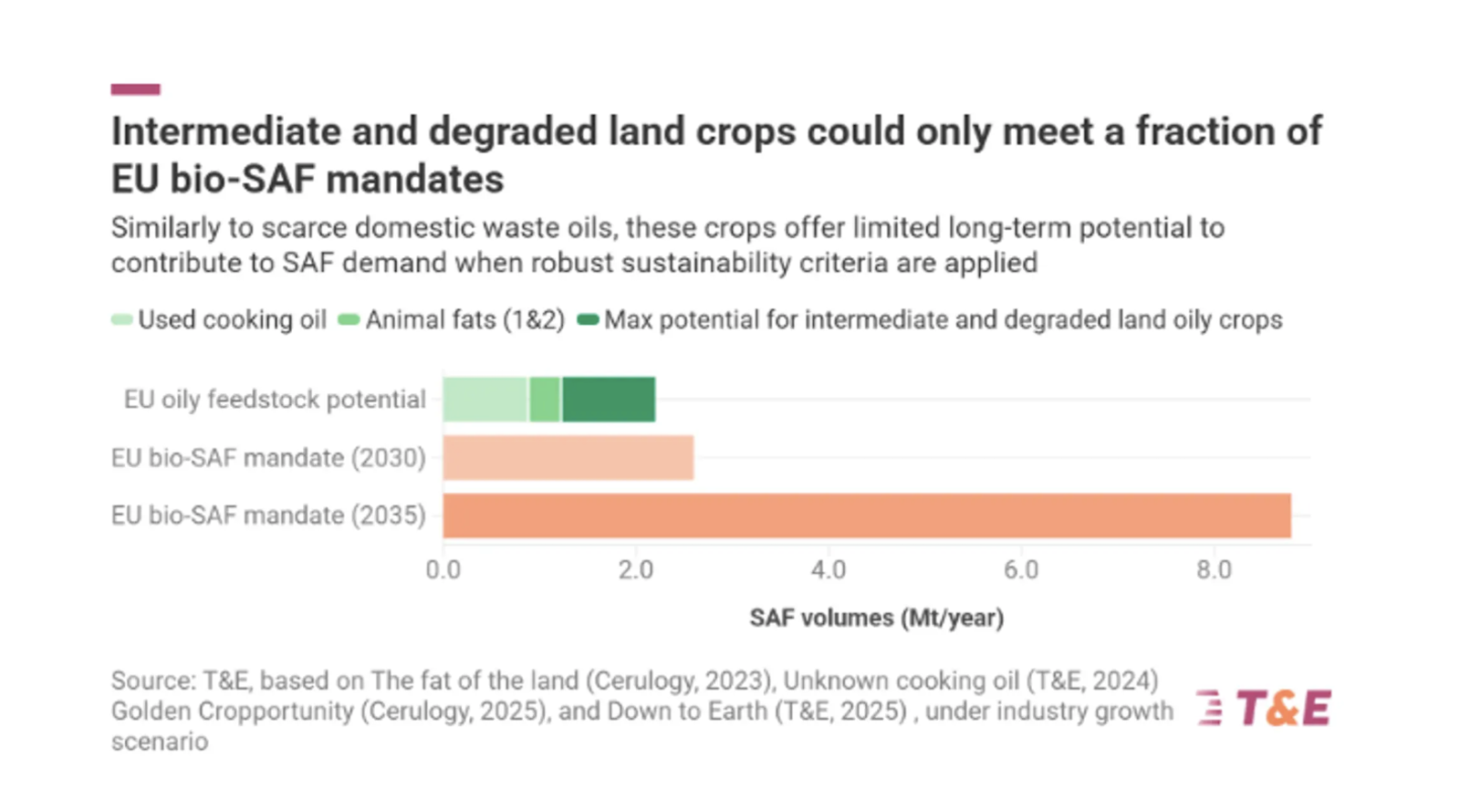
Transport & Environment released research debunking claims that intermediate crops and degraded-land agriculture offer a scalable solution for European sustainable aviation fuel (SAF) production. The study finds these approaches could supply only 4% of the EU's bio-SAF demand by 2050, far below what aviation decarbonization requires.
Intermediate crops, planted between food harvest cycles, and biomass grown on severely degraded land have gained traction as seeming workarounds to avoid competing with food production. Airlines and fuel producers have promoted them as low-impact feedstocks. The T&E analysis shows this framing misses the math.
The EU's RefuelEU Aviation mandate requires airlines to use increasing percentages of sustainable fuels, reaching 70% blended into jet fuel by 2050. Meeting that target across the bloc's aviation sector demands hundreds of millions of tons of biomass annually. Intermediate and degraded-land crops cannot bridge that gap, the report concludes.
Land availability emerges as the binding constraint. Europe lacks sufficient suitable area, even accounting for marginal lands. The study factors in realistic crop yields, growing seasons, and the biological reality that severely degraded soil produces less biomass, not more. Winter crops grown between main harvests also face climate limitations in northern EU regions.
The findings align with earlier research from the International Energy Agency and the European Environment Agency, which identified similar yield and scalability barriers for low-risk biomass sources. T&E argues the gap creates a choice: Europe must either dramatically increase biofuel imports, likely triggering land-use pressures in producing countries, or accelerate synthetic fuel development and electrification of ground transport to reduce aviation's absolute fuel demand.
Aviation accounts for roughly 2.4% of global CO2 emissions. The sector has few near-term alternatives to liquid fuels for long-haul flights, making